
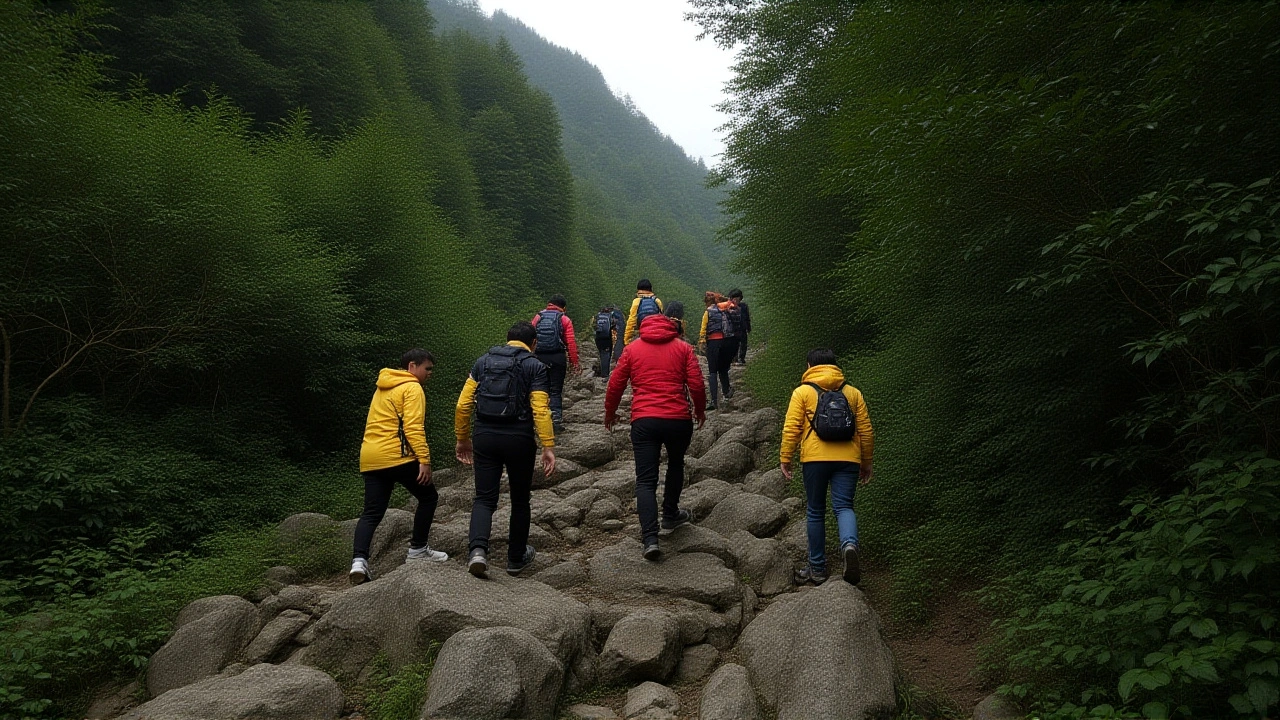
A tourist walked away from a 130-foot fall at Huaying Mountain in Guang'an, Sichuan province, China — not because of luck alone, but because the laws of physics somehow bent in his favor. The fall happened on or before December 8, 2025, when the ground beneath him crumbled as he leaned into position for a selfie. Onlookers screamed. Cameras rolled. And against all odds, the man lived to tell the tale — posting a shaky video message on social media with one simple phrase: "I'm so lucky."
How a Selfie Turned Into a Death Drop
The tourist, whose identity remains unconfirmed, was standing near the edge of a rocky outcrop known for its panoramic views — a spot popular with visitors seeking the perfect photo. According to footage released by The Sun, the terrain gave way without warning. No railings. No warning signs visible in the video. Just a sudden shift in the rock face, a stumble, and then a 130-foot plunge down a steep, jagged slope. The fall lasted nearly three seconds — long enough for bystanders to register horror, but too short for anyone to react.What made this especially chilling was the sound: the crunch of stone, the gasp of the crowd, then silence — until a distant, muffled groan echoed from below. Rescue teams arrived within minutes, drawn by the commotion. By the time they reached him, the man was conscious, sitting up, and clutching his phone — still recording.
The Aftermath: No Official Details, But a Social Media Surge
Despite the global attention, Chinese authorities have released no official statement about the man’s condition, medical treatment, or whether he was transported to a hospital in Guang'an or nearby Chongqing. No hospital records have been confirmed. No family members have spoken publicly. Yet the man’s own social media post — a 17-second clip showing him bruised but smiling — went viral across Weibo, TikTok, and Instagram within hours."I didn’t think I’d see my family again," he said in the clip, his voice trembling. "I thought I was dead. Then I felt my leg… and I knew I wasn’t." He didn’t specify injuries, but visible bruises on his arms and a swollen cheek suggest trauma. No broken bones were confirmed, but medical professionals familiar with similar cases say survival at this height often involves a combination of terrain, body position, and sheer chance.
Why This Isn’t Just a Fluke
This isn’t the first time a selfie has nearly cost someone their life. In 2019, a Russian tourist died after falling from a cliff in the Grand Canyon while trying to get a "perfect" shot. In 2021, three teenagers in India fell to their deaths from a waterfall near Mumbai while posing for a group selfie. And in 2023, a woman in Nepal survived a 70-foot drop after stepping on loose rock — she broke three ribs and her collarbone. The pattern is chillingly consistent: people ignore safety barriers, underestimate terrain, and prioritize the photo over their survival.Huaying Mountain, part of the larger Daba Mountain range, attracts over 1.2 million visitors annually. Its cliffs are notoriously unstable, with frequent rockfalls reported during rainy seasons. Yet, signs warning against approaching edges are either missing, faded, or ignored. Locals say the tourism board has been slow to install barriers, fearing they’ll "ruin the view." For now, the mountain remains a photographer’s paradise — and a death trap waiting to happen.
What’s Being Done — And What Isn’t
In the wake of the incident, local officials in Guang'an announced they’d "review safety protocols" at major viewpoints. But no new barriers have been installed as of December 12, 2025. Meanwhile, Chinese social media influencers are already posting "selfie challenge" videos from the same cliff — now tagged #HuayingSurvivor."People don’t think it’ll happen to them," said Dr. Li Wen, a trauma specialist at Sichuan University’s medical school. "They see a cliff and think, ‘I’m careful.’ But when you’re focused on framing your face, your balance, your peripheral awareness — all of it goes out the window. The body doesn’t care how good your camera is. It only cares about gravity."
The Bigger Picture: Tourism vs. Safety
China’s tourism industry has boomed since 2020, with domestic travel rebounding to 90% of pre-pandemic levels. But infrastructure hasn’t kept pace. At least 14 tourist deaths linked to selfie-related accidents have been reported in China since 2020 — and that’s only the ones officially recorded. Many go unreported, especially in remote areas like Huaying Mountain.Compare this to Japan’s Mount Takao, where guardrails, motion sensors, and automated voice warnings have reduced accidents by 78% since 2021. Or Yosemite National Park, where fines of up to $5,000 are now issued for climbing restricted areas to take photos. China’s approach remains reactive — not preventive.
"We need to stop treating these as ‘accidents’ and start treating them as preventable tragedies," said Wang Jian, a safety consultant who advised the Sichuan tourism bureau in 2023. "You can’t rely on tourists being smart. You have to design the environment so they can’t be stupid."
What’s Next?
The tourist’s social media account has since gone private. His phone, reportedly recovered from the rocks, is believed to contain the full 47-second video of the fall — which has not been released publicly. Authorities have not indicated whether they’ll investigate the site’s safety compliance, nor have they confirmed if he’ll face any penalties for trespassing or ignoring posted warnings.But one thing is clear: as long as the perfect selfie is worth risking your life, someone else will climb that edge. And someone else will fall.
Frequently Asked Questions
How is it possible to survive a 130-foot fall?
Survival at this height is rare but not impossible. Factors like landing on a sloped, vegetated slope — rather than flat rock — can reduce impact force. Body position matters: landing on the side or back distributes force better than head-first. In similar cases, survivors often have internal injuries or fractures but avoid fatal trauma due to terrain cushioning and quick medical response.
Why weren’t there safety barriers at Huaying Mountain?
Many popular tourist sites in China, especially in mountainous regions, lack barriers due to aesthetic concerns and cost. Officials fear railings will spoil natural views and deter visitors seeking "authentic" experiences. Though safety audits are required, enforcement is inconsistent, particularly in remote areas with high seasonal traffic.
Has this incident led to any policy changes?
As of December 12, 2025, no official policy changes have been announced. Local authorities said they would "review" safety measures, but no new signage, barriers, or surveillance systems have been installed. In contrast, similar incidents in Japan and the U.S. triggered immediate infrastructure upgrades within weeks.
How common are selfie-related accidents in China?
At least 14 documented deaths and dozens of serious injuries linked to selfie-taking have occurred in China since 2020, according to government-published accident logs. Many more go unreported, especially in rural or unregulated sites. Huaying Mountain is one of 17 locations flagged by tourism safety groups as high-risk for such incidents.
What should tourists do to stay safe at scenic cliffs?
Stay at least 6 feet away from any edge, even if it looks solid. Use a selfie stick or tripod instead of leaning out. Check for loose rocks or vegetation that could mask instability. And most importantly — put the phone down. No photo is worth your life. If you can’t take the shot safely, you shouldn’t take it at all.
Will the survivor face legal consequences?
It’s unlikely. Chinese law rarely penalizes accident victims, especially when no malicious intent is involved. Unless he was trespassing in a strictly prohibited zone — which isn’t clear from available footage — authorities are more likely to use this as a case study for improving safety than to punish him.





16 Comments
i just saw the video and like… he was literally leaning out like a toddler trying to get a selfie with a dinosaur at a museum?? no railings?? no signs?? this is wild. i’m not even mad, i’m just impressed he didn’t turn into a pancake.
you know what’s sadder than the fall? the fact that people are already turning this into a ‘selfie challenge’ on tiktok. we’re not just ignoring safety-we’re glorifying it. the guy’s lucky, sure, but this isn’t a win. it’s a warning we’re too lazy to listen to.
so let me get this straight… the mountain’s basically a death trap, the government’s like ‘eh, it’s scenic,’ and now we’ve got influencers doing backflips off the edge for clout? i’m not shocked. just deeply, deeply tired.
he’s lucky?? more like he’s a walking lawsuit waiting to happen. someone’s gonna sue the mountain. or the wind. or gravity. 🤷♀️
did you know the rock was actually a hologram? the government’s testing a new distraction tech to keep tourists from noticing the drone surveillance. he didn’t fall-he was *selected*. 🌀
obviously, this is what happens when you let the plebeians have access to scenic vistas without a proper cultural literacy test. if he’d studied Heidegger before climbing, he’d have understood the ontological peril of the selfie.
i just hope he’s okay. no one deserves to go through that. even if they were dumb.
the real tragedy here isn’t the fall-it’s the lack of biofeedback integration at tourist sites. if the terrain had been IoT-enabled with real-time pressure sensors, we could’ve triggered an AI-guided retargeting protocol to redirect his gaze. this is infrastructural negligence on a systemic level.
it’s easy to judge, but imagine being there-sun on your face, the view, the urge to capture it… you don’t think about falling until it’s too late. maybe we need more compassion, not just warnings. we’ve all been that person.
china lets people do this?? in america, you’d be fined $10k and arrested for even getting close. this is why our country’s still #1. 🇺🇸
he survived. that’s the story. the rest is noise.
in our tradition, we believe that when one survives against all odds, it is not merely luck-it is the grace of nature herself, blessing the soul who dared to seek beauty. let us honor his survival with humility, not mockery. the cliff did not kill him; the arrogance of the lens did. May we all learn to see without capturing.
you know, i’ve climbed many mountains in india, and i can tell you-there’s no such thing as a safe cliff. every ledge looks solid until it isn’t. i always carry a rope, even for selfies. i’ve seen friends disappear because they thought ‘it’ll be fine.’ this guy? he got lucky. but luck doesn’t come twice. please, for the love of your family-use a tripod. stand back. breathe. the photo won’t disappear. you might.
it’s fascinating how the human brain prioritizes social validation over biological survival. neurologically, the dopamine spike from a ‘like’ overrides the amygdala’s fear response. we’ve engineered a culture where the reward system is hijacked by aesthetics. this isn’t just a tourist mistake-it’s a cognitive bias on a global scale.
the institutional failure here is profound. while nations like Japan have invested in sensor-based safety infrastructure and automated public advisories, China continues to treat tourism safety as an aesthetic compromise rather than a public health imperative. the absence of barriers at Huaying Mountain is not negligence-it is a policy failure of the highest order. The state must prioritize life over landscape.
and now the survivor’s phone has the full 47-second video… and it’s locked behind a private account. i bet the government’s got a copy. and i bet they’re editing it.